How to make AI history videos that are accurate and worth watching
History is one of the strongest faceless niches, and AI has made it far easier to show the past instead of describing it. Here is how to make AI history videos, including the POV style, without getting the facts or the labels wrong.
By the FacelessHype team
7 min read
In this guide
- Two styles of AI history video
- How are AI history videos made?
- How to make POV history videos
- Keep the history accurate
- Do AI history videos need an AI label?
- How to make AI history videos with FacelessHype
- Eight AI history video ideas
- Keep the channel original
- How long should an AI history video be?
- Quick answers
AI history videos are short videos that tell a true story from the past, or show what an ordinary day looked like in another century, with AI made pictures or clips for every scene and a narrator telling it. They let a faceless channel show a medieval market or a sailing ship instead of using the same few old paintings everyone else uses.
This guide covers how to make AI history videos step by step, the two styles that work best on Shorts and TikTok, how to keep them accurate, and when YouTube and TikTok expect an AI label.
Two styles of AI history video
Most history Shorts fall into one of two shapes:
| Style | What it is | Example |
|---|---|---|
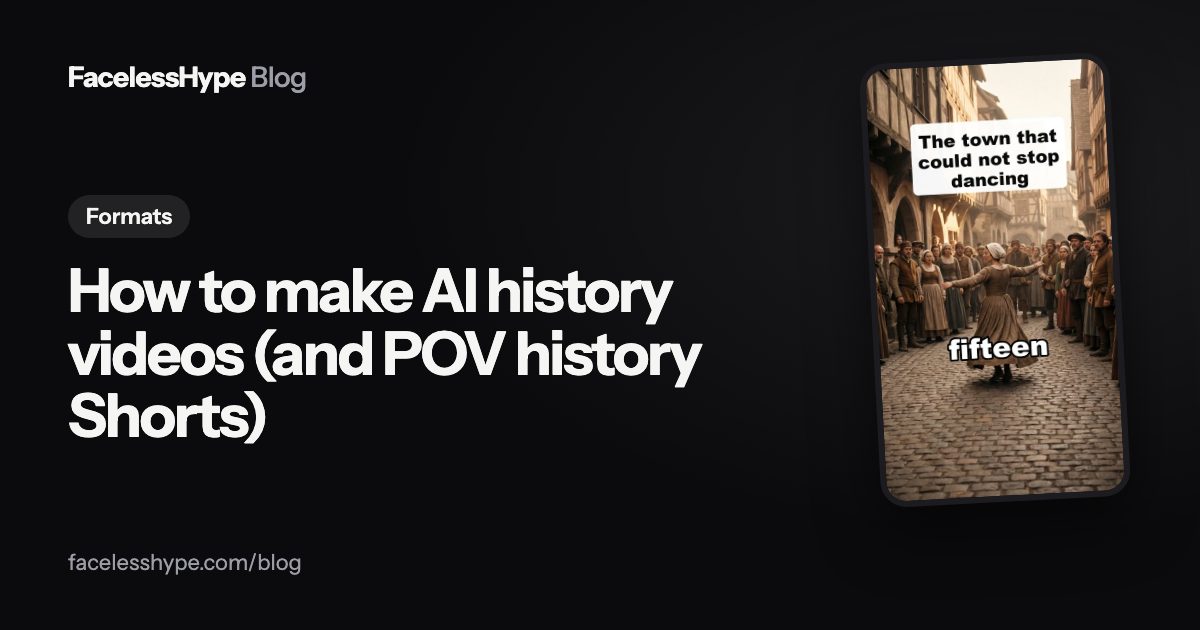
| Strange true story | A real event, told in under a minute, with a hook and a turn | The dancing plague of 1518 |
| POV history | "You" wake up in another time and live one ordinary day | POV: your first day building the pyramids |
Strange true stories win on surprise: the viewer cannot believe it really happened. POV history wins on immersion: every line says "you", so the viewer is the main character. Our history format and history POV format are built for each.
How are AI history videos made?
Whatever tool you use, the steps are the same:
- Pick the story or the day. A true event with one strange detail, or a time, place and job for POV ("a sailor in 1720").
- Research it. Read at least two reliable sources: an encyclopedia entry, a museum page, a university source. Note what is known and what is a best guess.
- Write the script. Short lines, the strangest detail first, one turn in the middle, and an ending that lands.
- Plan the scenes. One picture or clip per line. Decide what each scene shows: the place, the clothes, the light, the action.
- Make the scenes with AI. Describe each one clearly, with the period, the place and what is happening. Keep main characters looking the same from scene to scene.
- Add the narrator. A warm, clear documentary voice suits true stories. A closer, quieter voice suits POV.
- Add captions and music. Captions for mute viewers, and music that fits the period without drowning the voice.
- Check it once more against your notes before you post. The pictures are where mistakes slip in.
For the writing side, see our guide to writing a YouTube Shorts script. For openers, video hooks has a "time stamp" formula that suits history especially well.
How to make POV history videos
POV history is one of the most searched ways to do history on short video. It works because it turns a lesson into an experience. The rules:
- Every line says "you". "You wake up before the sun. The straw under you is damp."
- Stay with one ordinary person. Not the king. The baker, the farmer, the sailor, the apprentice. Viewers relate to them.
- Use the five senses. What the day smells like, sounds like, tastes like. That is what makes it feel real.
- Follow the day in order. Waking up, work, food, danger, night. A simple clock keeps the story moving.
- End with a sting. The last line reveals what usually happened next, or what was waiting at the end of the day.
Where you do not know a detail, say so. "Most people at the time probably ate..." is honest, and it does not break the spell.
Keep the history accurate
Accuracy matters more for AI history videos than for most formats, because AI photos can look convincing even when they are wrong. Common slips:
- Wrong clothes or tools. Armour from the wrong century, glasses in a scene before they existed, the wrong flag.
- Famous myths. Plenty of "facts" that spread online are not true. Check any detail that sounds too perfect.
- Made up quotes. If a real person never said it, do not put it in their mouth on screen.
- Faces of real people. AI can produce a believable face for a real historical person. If it is a guess, keep it stylised or say it is an illustration.
A simple habit: keep a short notes file for each video with the sources you used, and pin a source in the description or the first comment. It builds trust with viewers who care about history, and those viewers comment a lot.
Do AI history videos need an AI label?
This is the part people miss. YouTube asks creators to disclose altered or synthetic content when it is realistic and it "Alters footage of a real event or place". One of the help page's examples of content that needs a label is "a realistic depiction of a tornado or other weather events moving toward a real city that didn't actually happen."
For history, that means:
- Photoreal scenes of a real event that a viewer could take for real footage or real photos: turn on the label.
- Clearly illustrated or painterly styles, and POV scenes that are obviously a reconstruction: usually no label is needed. The help page says a label for non photorealistic or animated content may appear in the description, not on the player.
TikTok's Community Guidelines require a label on AI content "that shows realistic-looking scenes or people", and say "We don't allow content that's misleading about matters of public importance". A realistic fake of a real historical moment, presented as real, is exactly the kind of thing that rule is about.
When in doubt, label it. It is one switch at upload, and it protects the channel.
How to make AI history videos with FacelessHype
In FacelessHype, pick the history or history POV format and type the idea in a sentence. The app writes the script, records the narrator, makes a picture or a moving scene for every line, and burns in the captions. For POV, every line says you, and the pictures show the day through your eyes. Scripts use well known facts and say when something is a best guess, but check key details before you post.
Eight AI history video ideas
True stories:
- The war that lasted shorter than a lunch break
- The towns that put animals on trial, with lawyers
- The libraries that chained their books to the shelves
POV ideas:
- POV: you are an apprentice in a medieval printing shop
- POV: you are a lighthouse keeper on the night of a storm
- POV: you are a child in ancient Rome on the first day of school
- POV: you are a cook on a ship crossing the Atlantic
- POV: you are a guard on the night a famous painting goes missing
Check each true story before you make it. Some popular versions add details that the sources do not support.
Keep the channel original
YouTube's monetization policies list "image slideshows" with "minimal or no narrative" and "AI-generated content made with generic or unoriginal templates giving the impression of mass production" as inauthentic. History channels can drift into this with the same voice, the same music and the same five stock paintings on every video.
What keeps a history channel clearly original: your own research, a voice viewers recognise, new scenes for every story, and a point of view (why this story matters, what it says about people). A channel built that way is far more than a slideshow.
How long should an AI history video be?
Long enough to tell the story and land the ending. Shorts can now run up to three minutes, which helps detailed POV days, but most strange true stories are stronger short. YouTube's Shorts guide puts it plainly: "Capture attention in the first few seconds to prevent viewers from scrolling." See how long a YouTube Short should be and the best faceless niches for where history fits.
Quick answers
How are AI history videos made? A researched script, a narrator voice, AI photos or clips for each scene and captions, edited into a vertical video.
Are AI history videos allowed on YouTube? Yes, if they are original and follow the rules. Realistic AI scenes of real events need the altered or synthetic content label.
What is a POV history video? A video where the viewer is the main character, living one ordinary day in another time, told in the second person.
How do I make sure the facts are right? Use at least two reliable sources, keep notes, avoid famous myths and made up quotes, and say when a detail is a best guess.
Sources
Platform rules change, so check the source before you rely on a figure.
- YouTube Help: Disclosing use of altered or synthetic content
- YouTube Help: Channel monetization policies (reused and inauthentic content)
- TikTok Community Guidelines: Integrity and authenticity
- YouTube Blog (April 8, 2025): Your guide to getting started with YouTube Shorts
- YouTube Help: Shorts up to three minutes
Written by the FacelessHype team. FacelessHype is not affiliated with YouTube or TikTok. Nothing here is a promise of views or income.